
Why does ChatGPT recommend your competitor instead of you?
You have a website. You publish content. You know your service deserves consideration.
Then you ask ChatGPT a question your potential customer might ask.
Your competitor appears. Your brand does not.
It is frustrating-but it is also a useful starting point. Before changing your entire marketing strategy, investigate what the answer actually shows.
Which businesses appeared? Which sources were linked? What question were those sources helping to answer?
The opportunity begins with understanding the gap.
Start with the question your buyer is asking
OpenAI explains that ChatGPT Search can turn a prompt into one or more targeted searches. It may run additional searches after reviewing initial results. Its results use multiple factors intended to surface relevant, reliable information; placement is not guaranteed.
That makes the buyer’s question an important place to begin.
Someone asking for help with a specific business problem needs more than a general introduction to your company.
Imagine a founder searching for an agency that can explain why their website attracts visitors but few relevant enquiries.
Would your website help that founder understand your approach? Or would it leave them with broad promises about growth and innovation?
At Brand To Bytes, our recommendation is to review your content through the customer’s decision, not just your service list.
Being mentioned and being cited are different
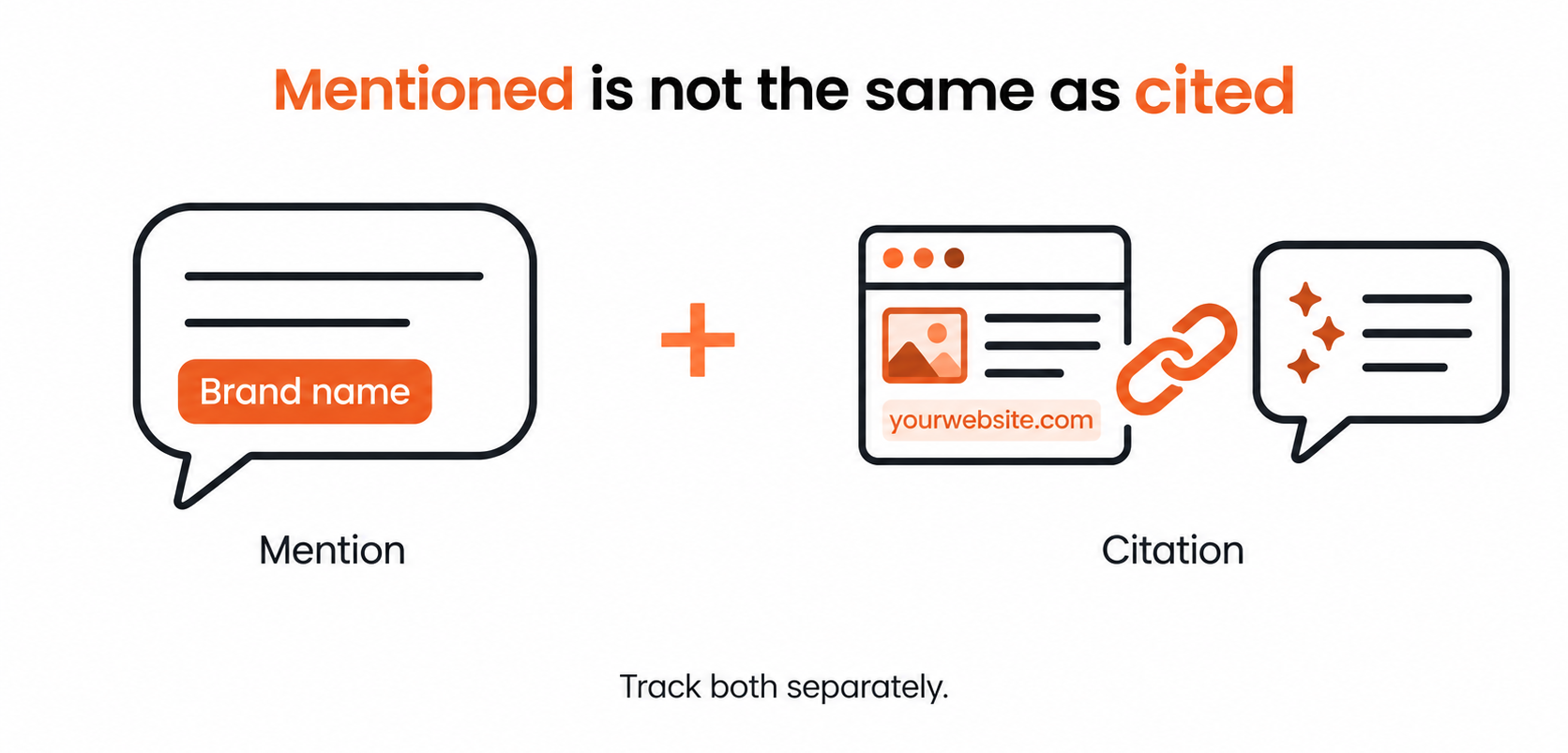
AirPulse’s guide highlights a useful distinction: a mention is your brand appearing in the answer; a citation is a linked source. Track whether your own website is cited separately from whether your name appears.
For example, an answer could mention your business while linking to an independent article. Another could link to your research without prominently naming your company.
Those observations tell you different things. Neither, on its own, proves that someone visited your website or became a customer.
Give each outcome its own place in your reporting.
Your website needs to explain the fit
A homepage has a broad job. It introduces your business, establishes credibility and helps people find their way.
A buyer with a specific problem may need a more focused explanation.
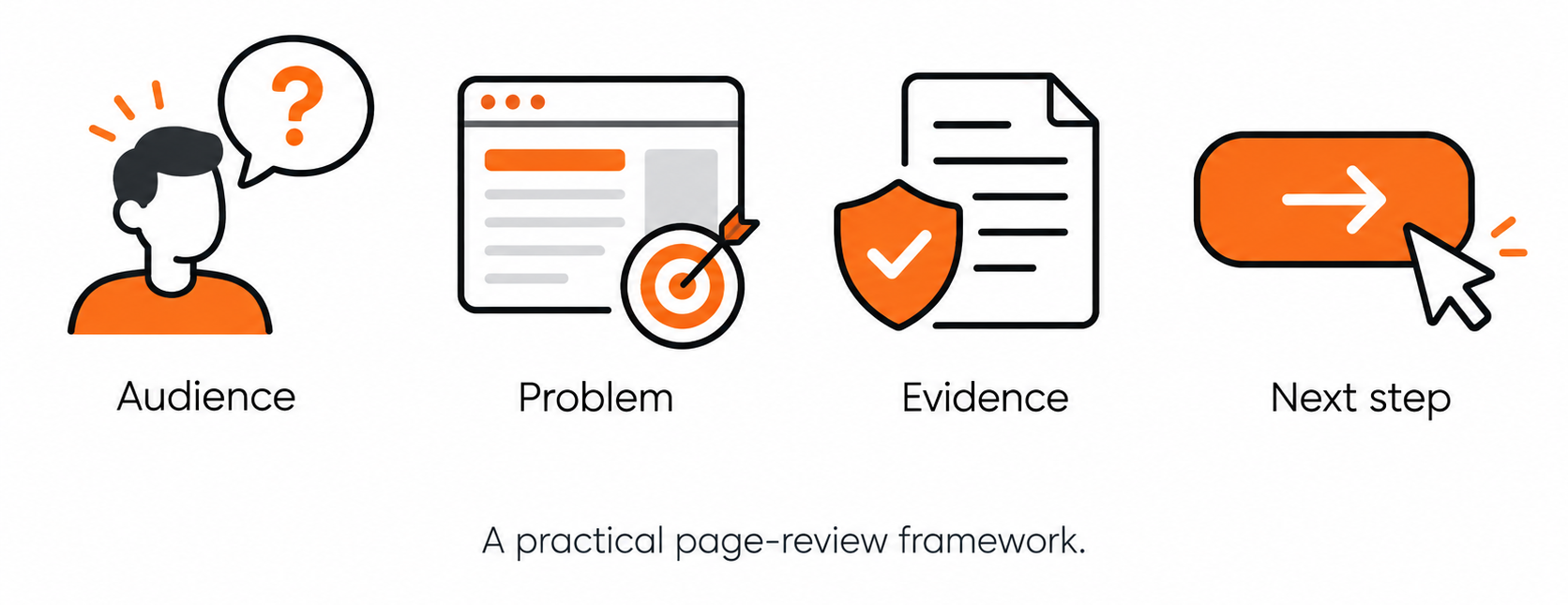
Our suggested page review uses four questions:
Audience: Who is this service suitable for?
Problem: What situation does it help address?
Evidence: What supports your claims?
Next step: What should an interested buyer do?
Consider the difference between “We deliver innovative digital solutions” and a clear account of how you investigate weak enquiry quality.
The second gives a potential customer something concrete to evaluate.
Explain your process. Show relevant examples. State limitations honestly. Make it possible for someone to understand when your service fits—and when it does not.
This is a practical content framework, not a formula for guaranteed AI recommendations.
Check whether your content can be accessed
Content quality and technical access deserve separate checks.
OpenAI says websites should allow OAI-Searchbot and ensure their hosting or content delivery network permits its published searchbot IP addresses to be eligible for inclusion. Eligibility does not guarantee placement.
Ask your technical team to check access before assuming that rewriting copy will solve the problem.
For Google’s AI search features, Google similarly points website owners toward established SEO foundations, technical requirements and helpful, reliable content. That is guidance for Google’s systems, rather than a guarantee about ChatGPT.
The practical lesson: review both what your page says and whether the relevant systems can reach it.
Build a baseline before making changes
AirPulse recommends repeating buyer prompts and recording the brands and cited URLs rather than relying on one screenshot.
For your own review, keep a simple record of:
The exact question.
The date, platform and search setting.
Brands mentioned.
Your website citations.
Other cited sources.
Then inspect the linked pages.
Treat them as evidence to examine, rather than proof that one headline or page format caused the result. An answer does not expose every reason behind a recommendation.
Choose a focused improvement, document what changed and review again. Keep the comparison as consistent as practical.

Avoid turning the audit into a content factory
Our advice is to resist the urge to publish dozens of similar pages immediately.
Start with one important customer decision. Find out what information is missing, unclear or unsupported.
Perhaps your service page does not explain who it serves. Perhaps your case study describes deliverables but leaves out the starting problem. Perhaps an important claim has no evidence a buyer can inspect.
Fix the specific weakness you can identify.
A useful audit should leave your team with a clearer priority, an owner and a way to review progress.
Make your brand easier to evaluate
At Brand To Bytes, we approach AI visibility as a combination of clear positioning, useful content, technical access and disciplined measurement.
The aim is to help people understand your business wherever they encounter it.
When a competitor appears in an AI answer, use that moment to ask better questions about your own visibility. Investigate the sources, review your pages and build a record you can learn from.
Want to understand where your brand is being missed? Connect with Brand To Bytes to discuss your AEO, GEO and AI visibility priorities.
Curious about paid visibility too? Explore how ChatGPT ads work, what they cost, and how targeting and the ad library fit in.

Comments