
What’s worse than being unknown? AI knowing your brand but recommending your competitor?
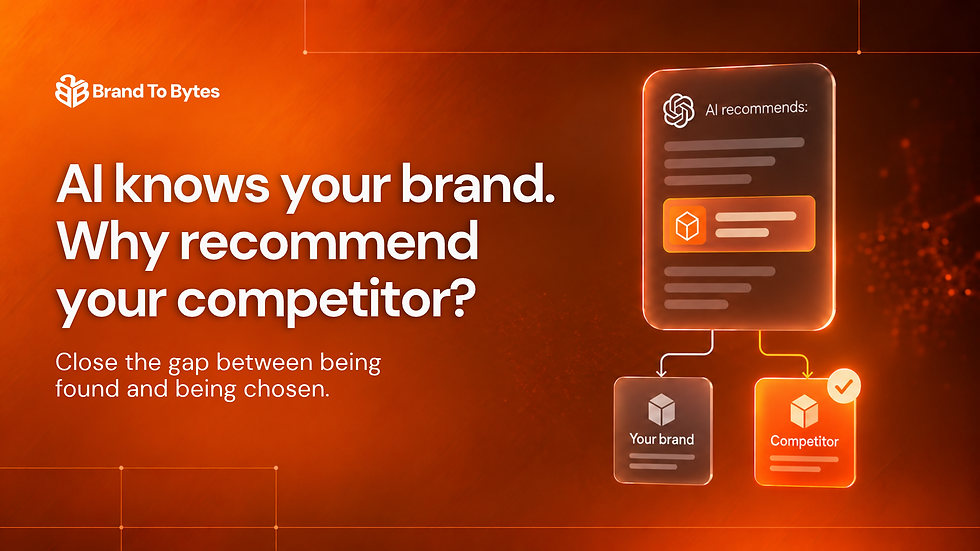
Imagine a potential customer asks ChatGPT about your business.
It describes your services. It recognises your category. It even mentions your name.
Then comes the question that matters: “Which company should I choose?”
Your competitor gets the recommendation.
Your brand appeared in the conversation, but someone else made the shortlist.
That is why AI visibility needs to go beyond counting mentions. The bigger question is whether your business appears in the right context, with enough relevant information and evidence for someone to consider it.
Closing that gap starts with how your website works as a whole.
Good content needs a connected website
Your team publishes blogs. Your developer handles technical fixes. Your sales team collects customer success stories.
But do those efforts connect?
A useful article might never link to the relevant service. A strong customer story might sit inside a sales presentation instead of on your website. Your homepage might promise “innovative solutions” without explaining who those solutions help.
Holistic SEO brings content relevance, technical accessibility and credibility into the same strategy. These elements support each other, and weaknesses in one can limit the value of the others. riseopp.com
For a B2B business, the practical question is straightforward:
Can someone discover your website, understand your expertise and find a convincing reason to contact you?
A mention is not a recommendation
Consider two hypothetical answers.
“Brand A provides marketing services.”
“For an early-stage B2B software company looking for positioning and demand generation support, Brand B is worth evaluating because its services and published examples match those needs.”
Both businesses are visible. The second is connected to a specific buying situation.
These examples do not reveal how an AI system makes decisions. They offer a useful way to assess your content.
Does your website clearly explain who you help, which problems you solve, how you work and what supports your claims?
A buyer should not have to interpret vague language to understand whether your business fits their needs.
“Marketing solutions for ambitious businesses” says very little.
“Positioning and demand generation support for B2B software startups building their first repeatable sales pipeline” gives someone a clearer starting point.
Not every AI bot reaches your blog
A published page is not automatically a discovered page.
And a bot visiting your website does not automatically mean that your content will appear in an AI answer.
Different bots perform different jobs. OpenAI distinguishes between OAI-SearchBot for search discovery, GPTBot for crawling content that may support model training, and ChatGPT-User for certain user-triggered visits. Search and training permissions are separate. developers.openai.com

Before publishing more content, check whether the pages you already have are accessible to the intended search crawler.
Start with the pages closest to a business decision: services, product information, case studies and useful expert articles.
Ask your technical team to review access through your robots.txt settings, hosting and security infrastructure. OpenAI recommends allowing OAI-SearchBot and its published IP ranges for search access. developers.openai.com
Access makes discovery possible. It does not guarantee a citation or recommendation.
Give people a reason to visit beyond the answer
If your blog repeats information available on dozens of other websites, what makes someone need your page?
That question matters when search results can answer part of a query before a person clicks.
Pew Research Center’s analysis of browsing data from 900 U.S. adults found that traditional search results received clicks in 8% of Google visits with an AI summary, compared with 15% without one. The browsing period was March 2025. These findings show an association, rather than proving that AI summaries caused the difference. www.pewresearch.org

The practical response is to make your website worth visiting.
For a B2B brand, that could mean explaining an implementation challenge your team solved, sharing original research, publishing a useful comparison or showing how a customer outcome was measured.
A definition can explain what something means.
Your experience can help someone decide what to do next.
Build content around buying questions
Imagine you sell customer support software.
An introductory article explains the category. But a serious buyer also needs to understand migration effort, integrations, pricing assumptions, security requirements and suitability for their team.
Those questions deserve clear answers.
They may belong on a product page, in a comparison table, inside an implementation guide or within a detailed customer story. They do not necessarily require a separate blog for every keyword variation.
Google’s guidance continues to emphasise SEO foundations and useful, original content for its generative AI search features. It also cautions against creating pages for every query variation primarily to manipulate visibility. developers.google.com
Plan content around the information your audience needs to make progress.
Then connect those resources with relevant internal links, so someone reading an introductory article can easily find the practical details that follow.
Make your expertise easy to inspect
“Trusted by businesses” is easy to write.
A customer story with a defined problem, a clear approach and a measured outcome gives readers something more useful to assess.
Review the strongest claims on your website. Beside each one, ask: what evidence can someone inspect?
That evidence might be a product demonstration, an expert explanation, a documented process or a case study that includes its timeframe and limitations.
For example, “We improved lead quality” leaves important questions unanswered.
What changed? How was lead quality defined? Over what period? What else could have influenced the result?
Clear answers help potential customers understand your work and its practical value.
Keep your business descriptions accurate across your website and relevant external profiles, too. An outdated service listing can create confusion about what you actually offer.
These improvements support clarity and credibility. They are not a formula that guarantees AI recommendations.
Measure what kind of visibility you are getting
One screenshot of an AI answer can start an investigation. It cannot establish a consistent pattern.
Choose a small set of questions your buyers genuinely ask. Include questions about your category, comparisons and specific use cases.
Repeat your checks and record the platform, date, exact question and cited sources.
Separate four outcomes in your reporting:
Mention: your brand appears in the answer.
Citation: the answer links to your content.
Recommendation: your business is suggested for the stated need.
Enquiry: someone takes a meaningful next step.
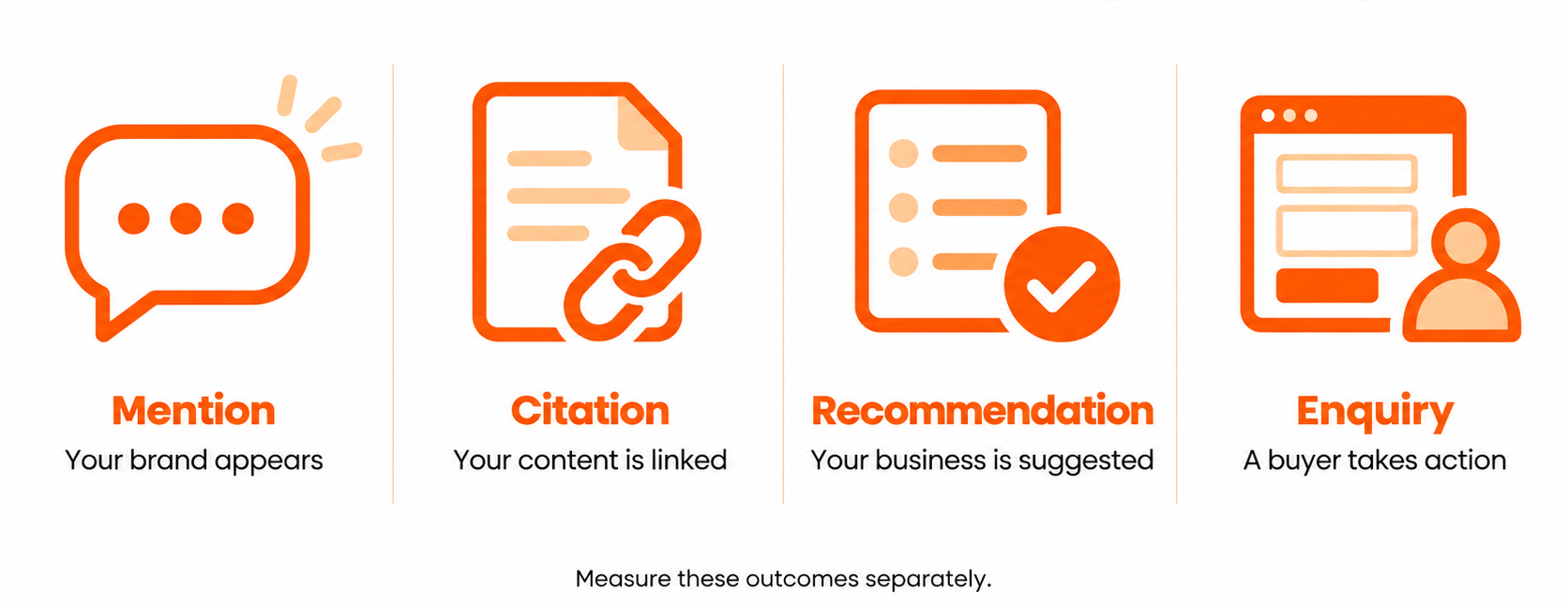
These outcomes tell different stories.
Your brand could be mentioned without a link. Your article could be cited without your service being recommended. A visit could happen without an enquiry.
Keeping those distinctions visible helps you understand what needs attention.
If people arrive but do not enquire, review the page experience and offer. If your business appears in an unsuitable context, review how you describe your audience and services. If relevant pages cannot be accessed, start with the technical issue.
Improve one important page before adding ten more
Choose a service page that matters to your business.
Check whether it is accessible. Clarify who it serves. Answer the questions a buyer would ask before contacting you. Add relevant evidence and links to supporting resources.
Then review what happens over time.

This creates a more useful starting point than increasing publishing volume without understanding the existing gaps.
At Brand To Bytes, we approach AI visibility, AEO and GEO through connected work across your website, content and brand positioning.
Being named can introduce your business. Clear relevance and credible evidence give people reasons to consider it.
Curious about the time between publishing and appearing in AI answers? Explore how long it takes to get cited in ChatGPT and why your competitor may already be there.

Comments