
How AI is changing agency work: Five shifts worth paying attention to

A client asks why its competitor appears in an AI answer. A strategist needs three distinct campaign ideas by tomorrow. An account lead has a weekly report to explain before the next call.
These are three different agency problems. AI is changing how teams approach each one. It’s also creating services clients can buy, including help understanding how their brand shows up in AI search.
Here are five ways agencies are putting AI to work, and what a B2B team can take from each.
1. AI search visibility is becoming a service clients can buy
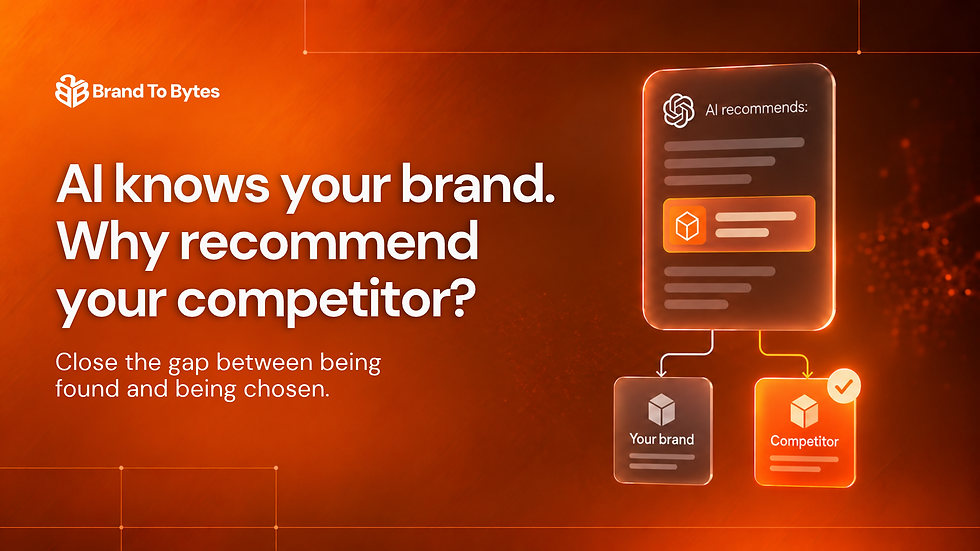
When a buyer asks ChatGPT or Gemini to compare providers, a brand may be mentioned, cited or left out of the answer altogether. For marketing teams, that raises a practical question: how does our business show up when buyers research our category?
In AgencyAnalytics’ 2026 survey, 66% of responding agencies reported increased demand for AI search services, making it the most requested new service category in the study.
Generative engine optimisation, or GEO, gives agencies a way to address that demand. Start with a set of real buyer questions, run them across selected platforms and record how the brand and its competitors appear. Then inspect the cited sources and identify gaps worth addressing, such as vague service pages or missing evidence for a key claim.
At Brand To Bytes, we see this as a natural extension of SEO and positioning. A useful AI visibility audit gives clients a baseline and priorities for improvement. It can’t promise a placement in an AI answer.
2. Creative teams can explore more directions before committing
An agency can use AI to try out different campaign angles, audience perspectives and visual treatments while an idea is still easy to change.
For Touchland’s fragrance mist launch, the agency Within used Gemini to explore audience profiles and a travel theme. The team developed that direction into “Move Your Mood,” a sweepstakes pairing eight fragrances with eight destinations.
The useful takeaway for a B2B team: ask for concepts that differ in what they communicate. If you’re launching workflow software, one idea could focus on missed handoffs, another on the time spent chasing approvals, and a third on what managers can’t see. Each gives the team a different proposition to evaluate against customer research.
Use AI to widen the options. Use the brief, brand guidelines and evidence to decide what deserves development.
3. Discovery calls can become better proposal briefs
The information you need for a proposal is often already in the discovery call. The time goes into finding it, sorting it and figuring out what the client actually agreed to.
At Born & Bred Creative, Garrett McClure uses AI to turn discovery recordings into structured sales briefs mapped to the agency’s scope phases. His team can then review the brief before shaping the proposal.
A useful starting template captures four things: the client’s goal, the problem they want solved, the scope discussed and the questions still open. With the right permissions and an approved tool, AI can prepare that first pass and draft a follow-up.
The account lead still needs to check the details. A date mentioned on a call may be a preference, and a service discussed may never have been agreed. Those distinctions matter once the proposal goes out.
4. Reporting can spend less time on compilation and more on decisions
AI can help compare reporting periods, flag unusual movements and draft a plain-language summary. That can give an account team more time to investigate what happened and decide what to do next.
At MK Aesthetics, Mitchell Kwan uses Claude to compare weekly Meta ad performance with the previous week and the account’s change log. He reviews the draft and makes the campaign decisions himself.
Take a report showing that cost per lead went up. The change is easy to flag. Before recommending a budget cut, the account lead might check whether tracking changed, whether the campaign reached a different audience or whether the leads were better qualified. The client needs the reasoning behind the recommendation as much as the number.
5. The small tasks that keep an agency running are worth a look
A decision gets made in Slack. Nobody updates the project board. The next morning, two people are working from different versions of the brief.
This is the kind of recurring problem where AI can help. Digital agency AXI uses AI to identify overdue tasks and blockers, and flag decisions in Slack that may need to become tracked work. Suff Digital reported that using Scribe cut the time it took to document a typical internal procedure from around 90 minutes to 30, including quality checks.
Pick a task that repeats across accounts: turning meeting decisions into action items, documenting a process or preparing a project handover. Give the output an owner who can catch misunderstandings before they become someone else’s work.
Start with one repeatable task
You don’t need to rethink the entire agency at once. Test one workflow where the input is clear and the result is easy to review.
Choose: Pick a recurring task, such as drafting the weekly account update.
Draft: Give AI a clear input and a template for the output.
Review: Assign someone to check the facts and approve the result.
Measure: Compare total time, including review and rework, with your current process.
The test is whether the change improves the work clients receive. If an hour saved on reporting gives your team time to investigate why lead quality changed, that’s a better use of AI than simply sending the same report sooner.
If AI search is where your clients are asking for help, start with our guide to optimising for AEO and GEO as a new brand.


Comments