
How will a brand being cited in a non-branded prompt, benefit from the AI-visibility cycle?
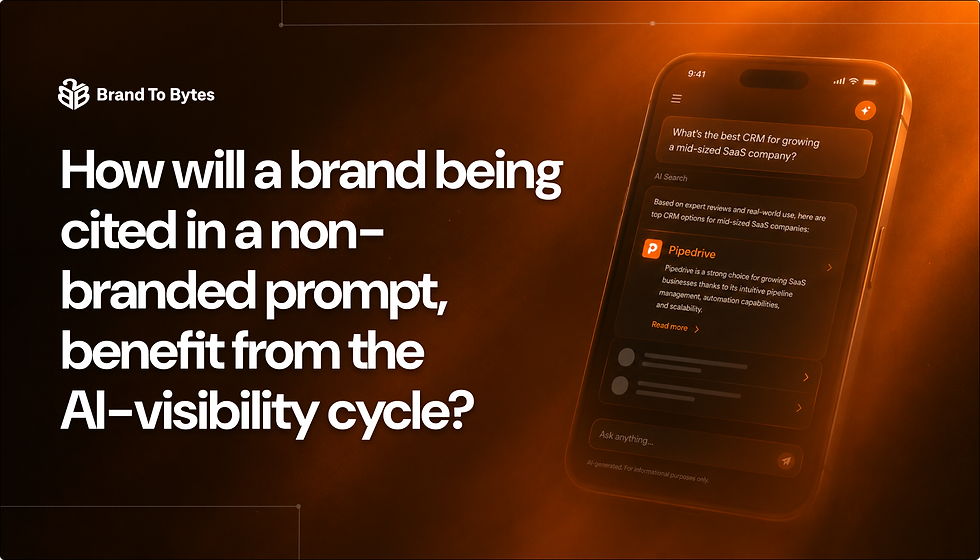
Key Takeaways: The article says brand visibility in AI matters most when a company shows up in non-branded prompts, since that’s often when buyers are still putting together a shortlist and figuring out which vendors should even be on it. In other words, it happens during early research, before they’ve picked favourites.
It describes an AI-visibility cycle where early citations can lead to clicks, branded searches, reviews, and other market signals that usually raise the chances of future mentions. In that context, the loop matters a lot, not just as a nice bonus.
The piece points to key drivers such as clear entity signals, useful content based on real problems, off-site mentions, and solid technical performance. It also says that slow or poorly structured sites can lower the chances of being cited, which is a real problem if AI systems need to find and reference those pages.
For B2B startups and growth-stage firms, the advice stays practical: track visibility across branded, non-branded, and comparison prompts; measure outcomes like branded search lift and demos; and treat AI visibility as a strategy that connects brand, SEO, and conversion work instead of splitting them up.
If your brand shows up when someone asks an AI tool a non-branded question like “best fintech CRM for startups” or “top webinar software for B2B teams,” that’s a big deal. Really, a very big one. It means your company joined the conversation before the buyer picked a favorite, which is usually the hardest stage. That’s often where real market share starts to form.
For B2B founders and marketing leaders, this changes the old search playbook. Before, success meant ranking near the top of Google for a category term. Now, AI tools often give one summarized answer with a short list of brands and cited sources. When your brand makes that list, you can build trust earlier, get more attention, and improve your chances of making the shortlist. That’s, in this view, the real strength of brand visibility in AI.
This article explains how the AI-visibility cycle works, why non-branded prompts can matter more than many branded searches, and which signals may improve the odds of future mentions. It stays practical, not fluffy, which is probably what most readers want. It also looks at what startup teams can do right now to build that edge, along with the data, common mistakes, and a simple way to measure progress.
Why non-branded AI prompts matter for brand visibility in AI
A branded prompt shows demand that already exists. A non-branded prompt can help create new demand. That’s the main difference, and it’s a big reason this matters.
When a buyer asks an AI tool about a problem instead of searching for a company name, they’re still shaping how they see the market. If your brand appears there, the AI has basically introduced it as a relevant option. That usually matters early, when buyers are deciding which names even make it onto their list. In B2B especially, many buyers build that shortlist pretty early and then spend the rest of the process comparing only a small group of companies.
Recent numbers make that easier to picture. Research cited in 2025 found a 70% decline in organic click-through rate when AI Overviews appear. At the same time, 90% of higher-intent buyers clicked at least one cited source after seeing those AI answers. So while general search traffic may drop, cited brands can still get real downstream value, especially with people who are already getting closer to a decision or at least narrowing down their options.
Key AI visibility signals shaping buyer discovery | ||
Metric | Value | Why it matters |
Organic CTR change with AI Overviews | -70% | Generic rankings alone are less reliable |
Higher-intent buyers clicking cited sources | 90% | Citations can still drive strong traffic and trust |
ChatGPT answers with citations | 2.8% in Aug 2025 | Citations are still limited, so inclusion stands out |
That’s why brands cited in non-branded prompts can still get attention even as traditional blue-link clicks keep falling. For startup teams with lower domain authority, this creates a real opening. In some cases, it’s a real chance to be seen next to much bigger names.
That also points to something bigger: AI visibility is about more than just a website. It often comes from a brand’s full digital footprint, including the places it appears and gets mentioned online. And that seems to matter more now than it did before.
How the AI-visibility cycle supports brand visibility in AI
The AI-visibility cycle often starts with one simple thing: a brand gets mentioned or cited in a non-branded answer, which is usually when people first notice it. From there, the effects can start building on each other, and that will likely become more noticeable over time.
Stage 1: Discovery before brand preference
A buyer asks, “What is the best payroll software for startups?” At that point, they do not know your brand yet. If AI mentions you, though, you appear in the payroll-software-for-startups category, which is often a key step. The buyer then starts connecting your name to a real business problem, probably right away.
Stage 2: Clicks, searches, or follow-up questions
A lot of users click the cited source. Others search for your brand name, visit your website, or sometimes ask a follow-up question like ‘Is this tool good for remote teams?’ These may seem like small actions, but often they probably make your brand easier to remember.
Stage 3: More market signals
That first mention can lead to small but useful things: new branded searches, direct visits, demos, social talk, reviews, founder mentions, and third-party content. In many cases, those are the kinds of signals AI systems will probably notice later.
Stage 4: Stronger future inclusion
As your entity gets clearer across the web, the chances of being found and mentioned again will often go up too. That’s the compounding effect, and it usually grows over time as signals get stronger.
If your team is still early in this process, this step-by-step guide to getting listed on LLMs is a good place to start, especially if you’re just starting out.
What improves brand visibility in AI over time
A lot of leaders think AI visibility comes from publishing more blog posts, but that alone usually isn’t enough. Research, I think, points to a wider mix of signals instead.
In Ahrefs research, branded web mentions showed a strong correlation with AI visibility, ranging from 0.66 to 0.71. YouTube mentions were even stronger, at about 0.737. On the technical side, Onely reported that sites with LCP greater than 4 seconds were 72% less likely to be cited. That’s a big drop, and a pretty steep one in practice. So when a site is slow or hard to crawl, it can cost citation opportunities, and brands often won’t notice that right away.
That gives B2B brands a clearer playbook:
Build clear entity signals
Keep your brand story the same across your site, social profiles, product pages, team bios, review sites, and media mentions. It really matters. AI systems usually work better when they can match the same company identity across all those places, and that’s often the key.
Publish content tied to buyer problems
Create pages that answer category or feature questions in simple, clear language, not jargon. Think “best AP automation workflows for mid-market finance teams,” instead of just product updates. Keep it short, useful, and easy to scan quickly.
Earn off-site mentions
Podcasts, webinars, partner pages, founder interviews, analyst roundups, review platforms, and YouTube can help grow your visibility, like in search. They often help more people see you, too. For teams learning more about answer engines, this guide to AEO and the new SEO landscape adds useful context.
Fix technical friction for brand visibility in AI
Fast pages, a clean site structure, strong internal linking, and content bots can still crawl really matter. That’s why a solid SEO readiness audit helps with AI visibility, not just search rankings.
A common mistake is treating AI visibility as only a PR issue or only an SEO issue. But in most cases, it also involves brand strategy.
Why this is a big advantage for growth-stage B2B companies
In some cases, this shift can help startups more than established companies. Traditional SEO usually rewards age, backlinks, and huge content libraries. AI systems do not always work that way. A younger brand can still earn mentions when it has useful content, clear positioning, strong category relevance, and enough third-party proof behind it, which is often a pretty big factor.
This tends to matter a lot in SaaS, fintech, and edtech. Buyers in these categories often compare vendors by use case rather than just brand awareness. Because of that, a founder-led company with sharp positioning can show up in AI answers even before it reaches the top three in classic search. For companies trying to get noticed early, that can be a real advantage.
Category positioning and brand visibility in AI
Take a seed-to-Series B fintech platform. It probably will not outrank major players for ‘best finance software.’ But it may still earn citations for narrower prompts like ‘best spend control software for remote startup teams’ if its content is focused and its category story is easy to understand. That is usually where smaller companies have a better shot.
This is also where firms like B2B Content fit naturally into the conversation. The value is not just in writing content. It also comes from matching brand positioning, conversion paths, and AI-driven discoverability so the right buyers find you earlier, before they start comparing vendors or building a shortlist, which is often the harder part.
Another common mistake is focusing only on branded prompts. If someone is already searching for your company by name, awareness already exists. The bigger growth lever is showing up in the answer set before buyers know who to ask for. In practice, that is often where category-level visibility matters most.
That reminder matters because success should be measured against your category, your prompt set, and your competitors, not against a single magic benchmark. That feels like a more useful way to judge what is actually working.
How to measure brand visibility in AI without making it too complicated
Getting started usually doesn’t need a big analytics team, which is probably a relief. A simple testing system and a prompt set you can reuse are enough. One good place to start is with a few prompt groups, since that’s often enough.
1. Branded prompts
These check if AI gets your company and your main offer, which is often the key part.
2. Non-branded category prompts
These are often your most valuable prompts for growth. Use the questions buyers ask before they know your name, which happens pretty often.
3. Comparison prompts
These show whether you appear when buyers compare options, look at alternatives, or weigh tradeoffs, which is often where decisions start. A practical starting point is 25 to 40 prompts, and early on it often helps to include more unbranded prompts than branded ones. Track:
Mention presence
Citation presence
Position in the answer
Sentiment or framing
Source domains cited
Competitor share of voice
It also helps to watch business outcomes after AI mentions, such as branded search lift, direct traffic, demo starts, and return visits. AI visibility usually matters when it supports pipeline, not just when a name appears in the answer.
As a rough benchmark, Similarweb suggests a meaningful visibility floor of around 5% to 8% in many sectors. A stronger competitive score often falls in the 7% to 20% range. In most cases, compare that with others in the same market.
Practical moves to strengthen brand visibility in AI
The goal is simple: make your brand easier to find again, easier to trust, and more likely to show up in search results and AI answers over time.
A good place to start is the website. The homepage, product pages, industry pages, and thought leadership should clearly explain who the brand helps, the problem it solves, and what makes it different, all in plain language. From there, it usually makes sense to keep going.
Founder-led content can connect expertise to real buyer pain in a way that often feels more helpful. Webinars can become articles. Customer questions can shape comparison pages. Product explainers may work well as short videos, and partner content often helps more than people expect. Off-site mentions matter too, so distribution now needs to be part of AI optimization. Additionally, teams can learn from broader findability frameworks for founders that connect SEO, AEO, and GEO strategies.
Align conversion paths with AI traffic
Conversion paths also need attention. If AI sends a high-intent visitor, that chance can be lost with vague messaging or slow pages when someone is ready to evaluate or buy. The AI-visibility cycle gets stronger when traffic leads to better engagement and stronger brand signals, for example through a clear, fast experience.
Frequently Asked Questions
What is a non-branded prompt in AI search?
A non-branded prompt is a question that does not include a company name. For example, ‘best CRM for SaaS startups’ is non-branded, while ‘HubSpot alternatives’ is branded. Non-branded prompts matter because they influence buyers before they have chosen a vendor.
Why is brand visibility in AI important for B2B companies?
It helps your brand appear during early research, when buyers are building a shortlist. That can increase trust, branded search, and website visits even if you are not dominating traditional search rankings. For B2B firms, early visibility can shape the full buying journey.
Does being cited by AI always lead to clicks?
Not always, but citations still matter. Some users will click the source, while others will remember the brand and search for it later. The strongest value often comes from high-intent research, where cited brands are more likely to get follow-up attention.
How can a startup improve its chances of being cited in non-branded prompts?
Focus on clear category positioning, useful content, strong site performance, and off-site mentions. A startup should also test prompts regularly and improve pages that answer real buyer questions. Teams that need both strategy and execution often look at agencies like B2B Content because AI visibility works best when brand, SEO, and conversion all support each other.
Is AI visibility the same as SEO?
No, but they overlap. SEO helps your content get found and trusted, while AI visibility depends on how AI systems retrieve, understand, and cite brands across many sources. Strong SEO supports AI visibility, but it is only one part of the picture.
What should marketing leaders measure first?
Start with share of mentions across a fixed prompt set, especially non-branded prompts. Then connect that to business signals like branded searches, direct traffic, demo requests, and sales conversations. If you want clearer tracking and content priorities, a specialist partner such as B2B Content can help map AI visibility to real growth outcomes without turning the process into guesswork.
Put this into practice now
When your brand gets cited in a non-branded prompt, it gets more than a simple mention. It appears early in the buyer journey, often before someone has formed a clear preference. That can have a big effect: more clicks, more branded searches, more discussion on other sites, and stronger entity signals that may support future AI inclusion. That’s the AI-visibility cycle in action, and it’s a pretty practical one.
For founders and growth-stage marketing teams, the takeaway is simple. AI visibility shouldn’t sit off to the side as a separate project. It needs a place in brand strategy, demand generation, and conversion planning now. One useful approach is to build pages around real buying questions, improve technical performance, grow off-site mentions, and track prompt-level share of voice. You’ll also want to keep improving the messages and pages that get repeated most often, since that part is easy to miss.
The teams that win brand visibility in AI usually aren’t the biggest brands. More often, they’re the clearest, most useful, and easiest to trust across the wider web. Not flashy, just consistent. In this view, that’s the best place to start, especially when buyers are researching, comparing options, and deciding who seems credible.


Comments